
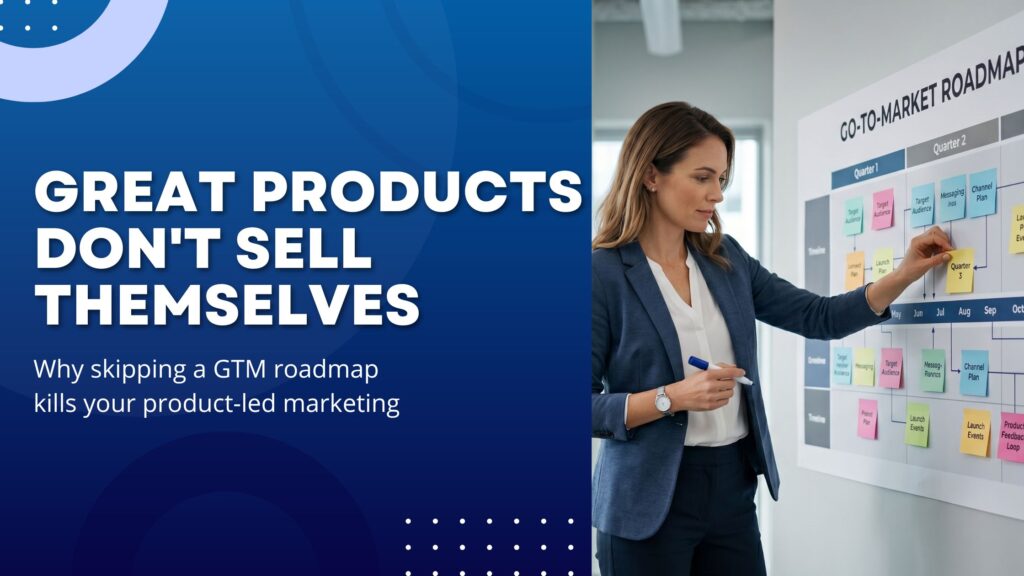
Product led marketing sounds like the dream. Let the product do the selling. Build something people love, make it easy to try, and watch adoption compound on its own. No heavy sales motion. No expensive outbound. Just a great product experience driving revenue.
Except that is not how it usually plays out.
Most B2B companies that commit to a product-led marketing approach hit a wall somewhere between initial traction and predictable revenue. The signups come in. The free trials are activated. But the pipeline does not convert the way it should, expansion is slower than expected, and the team cannot quite explain why. The product is working. The growth is not.
The reason is almost always the same. There is no GTM roadmap behind the product-led motion.
Product Led Marketing Is a Motion, Not a Strategy
This confusion lies at the heart of most product-led growth failures. Product-led marketing is a go-to-market motion. It describes how users experience and adopt the product. It is not, by itself, a strategy for acquiring the right users, converting them into revenue, or building a scalable commercial system.
When companies treat product-led marketing as a complete strategy rather than one component of a larger GTM system, they tend to optimize the product experience while leaving the commercial architecture completely undefined. They invest in onboarding flows, activation triggers, and in-app messaging – all genuinely important, while skipping the foundational questions that determine whether any of that investment compounds into revenue.
Who exactly is the product built for? What specific pain does it solve better than anything else in the market? How does a free user become a paying customer, and what does that motion look like at scale? Which accounts should the team be focusing expansion efforts on, and why?
Without answers to these questions, even a beautifully designed product experience will plateau. The difference between a GTM strategy and a marketing strategy matters enormously here, and conflating the two is one of the more expensive mistakes a product-led marketing company can make.
What Happens Without a GTM Roadmap
The failure pattern is consistent enough that it is worth walking through directly.
Acquisition becomes broad and shallow. Without a defined ICP, product-led marketing teams tend to let anyone sign up and hope the product self-selects the right users. It does not. You end up with a large base of low-intent free users who churn at activation and a much smaller number of genuinely qualified accounts buried inside that noise. The conversion math never works.
Activation does not translate to the pipeline. Free-to-play conversion depends on more than a well-timed in-app prompt. It depends on the right users being in the product in the first place, and on a commercial layer – sales, success, or both – that knows when to engage and how. Without a GTM roadmap defining that layer, activation becomes a metric disconnected from revenue.
Expansion stalls at the account level. Product-led growth can land deals efficiently. What it cannot do without structure is expand them. Turning a three-seat trial into a twenty-seat contract requires a human commercial motion, account intelligence, and a deliberate expansion playbook. That is a GTM problem, not a product problem.
Sales and marketing operate in separate lanes. This is one of the most documented and most preventable GTM failures in B2B. When the product team owns the growth motion in isolation, sales and marketing are rarely aligned around the same definition of a qualified opportunity. The GTM disasters that result from this misalignment are almost always traced back to the absence of a shared commercial plan from the start.
What a GTM Roadmap Actually Adds to a Product-Led Marketing Model
A GTM roadmap does not replace the product-led marketing motion. It gives that motion the structure it needs to produce revenue rather than just activity.
At the foundation, it answers the audience’s question with real precision. Not “developers at mid-market SaaS companies” but a tightly defined ICP that the entire team – product, marketing, sales, and success – operates from. This matters because a proper B2B GTM framework is what turns a good product into a repeatable revenue engine, and it starts with knowing exactly who you are building and selling for.
It also defines the commercial layer that no product-led approach can generate on its own. Who touches an account after free signup, and when? What is the trigger for a sales conversation? What does expansion look like for a healthy account versus one at risk? These questions require deliberate design, not organic emergence.
Perhaps most importantly, a GTM roadmap creates alignment. It gives sales and marketing a shared framework for what a good opportunity looks like in a product-led marketing context – which is genuinely different from a traditional sales-led model. That shared framework is what prevents the pipeline confusion that kills conversion rates at exactly the moment they should be climbing.
If you are at the stage where your product-led marketing motion is generating signups but not consistent revenue, the most effective next step is not another onboarding experiment. It is building a custom GTM roadmap that wraps your motion in the commercial architecture it needs to scale.
The Systemic GTM Point
There is a broader principle worth naming here. Growth hacking and tactical shortcuts plateau. Systems compound. A product-led marketing strategy without a GTM roadmap is, functionally, a very sophisticated growth tactic. It can generate impressive early numbers. It cannot, on its own, build a durable revenue business.
The companies that make product-led growth work at scale are not the ones with the most elegant onboarding flows. They are the ones that built the commercial system around the product experience – the ICP clarity, the messaging architecture, the sales-marketing alignment, the expansion playbook – and treated that system as seriously as the product itself.
That is what a GTM roadmap provides. And without it, even the best product-led marketing strategy will keep running into the same ceiling.
One More Decision Worth Making Carefully
Once you have the GTM roadmap in place, you will face a practical question: who builds and runs it? Whether you staff the GTM function in-house or through an agency depends on your stage, your speed requirements, and the internal expertise you already have. Both models can work. What does not work is leaving the roadmap unbuilt while the product-led marketing motion runs unsupported.
Product-led growth is not a strategy you can set and forget. It is a motion that requires a commercial system behind it. Build that system, and product-led marketing becomes one of the most efficient growth models in B2B. Skip it, and you will keep explaining to leadership why a product people love is not producing the revenue it should.
Syft Media works with B2B companies to build the GTM systems that make product-led marketing actually scale. If your motion is generating activity but not revenue, that is exactly the gap we help close.